One answer, three records
- Mention
- Named in the answer
- Citation
- Its website cited as a source
- Rank position
- Named first among competitors
How we measure visibility across ChatGPT, Claude, Gemini, Google AI Overviews, and Perplexity: the five surfaces customers use when they ask an AI for a recommendation.
Scope Today’s question set was built for medspas. Other local service businesses are handled case by case: ask us.
We ask five AI surfaces the questions your customers ask, and count how often each one names your business.
These are the five surfaces where a customer, today, can ask a question and get a direct recommendation that names specific businesses. Perplexity became the fifth in June 2026, once it was a primary answer engine for local discovery.
Measured against ChatGPT’s default model with web tools enabled.
Measured against Claude’s default model with web search enabled.
Measured against gemini.google.com’s default model.
The AI-generated summary block at the top of Google results, captured separately from Gemini because the surface, ranking factors, and citation behavior differ.
A web-search answer engine (Sonar). It leans heavily on Reddit and other user-generated content for local queries, a different citation profile from the others.
Every audit asks 36 types of question about a business. They fall into seven kinds. Four surfaces answer all 36 types; Google AI Overviews answers only the cost and consideration ones, half of the set.
One answer, three records
best kitchen remodeler near me?
The question
we test
For a kitchen remodel nearby, many people start with Example Remodeling Co., then Sample Builders.
Invented names, shown to explain what we record.
Named in the answer
Questions customers type
ExampleInvented examples, rotated across five trades to show the shape of each kind of question. The question set itself is written for medspas.
The medspa set has 36 patient query types, expanded into 162 query-runner combinations: the 36 questions run across the four chat surfaces (144) plus 18 cost and consideration questions routed only to Google AI Overviews.
Four surfaces answer all 36 question types. Google AI Overviews answers only the cost and consideration ones.
| Surface | Cost and consideration questions | All other questions |
|---|---|---|
| ChatGPT, Claude, Gemini and Perplexity | Asked | Asked |
| Google AI Overviews | Asked | Not asked |
The 162 combinations and the visibility rate in your report measure different things, so they never tally directly. Your report’s rate is drawn from a smaller, service-specific figure: only the questions relevant to services your own site shows you actually offer count toward it (your “offered” basket).
Questions about services we don’t find advertised are tracked separately as market demand, never counted as a visibility gap. The unit is unique questions, not query-and-surface combinations, so the same question is never double-counted across surfaces.
Cost and consideration questions run per service, not just in aggregate. A business can be named for the “best” questions and still be missing where a customer checks the price or weighs whether it is worth it, which is where the booking is decided.
Each of the 36 queries is run against ChatGPT, Claude, Gemini, and Perplexity, and the 18 cost and consideration queries are also run against Google AI Overviews. We vary the phrasing slightly, because the same intent asked three ways often returns three different sets of businesses.
For each question on each surface we record three things: whether the business was named, whether its URL was cited as a source, and where it ranked among the named competitors.
02 Improve
The method ends in a document. These are all three pages of our public sample report.
You get a short, ranked list of fixes, not a 40-item checklist. Each audit hands you one visibility index and the five changes that move it, ordered by projected lift. Your report ranks the fixes for your own gaps.
A finished
report example
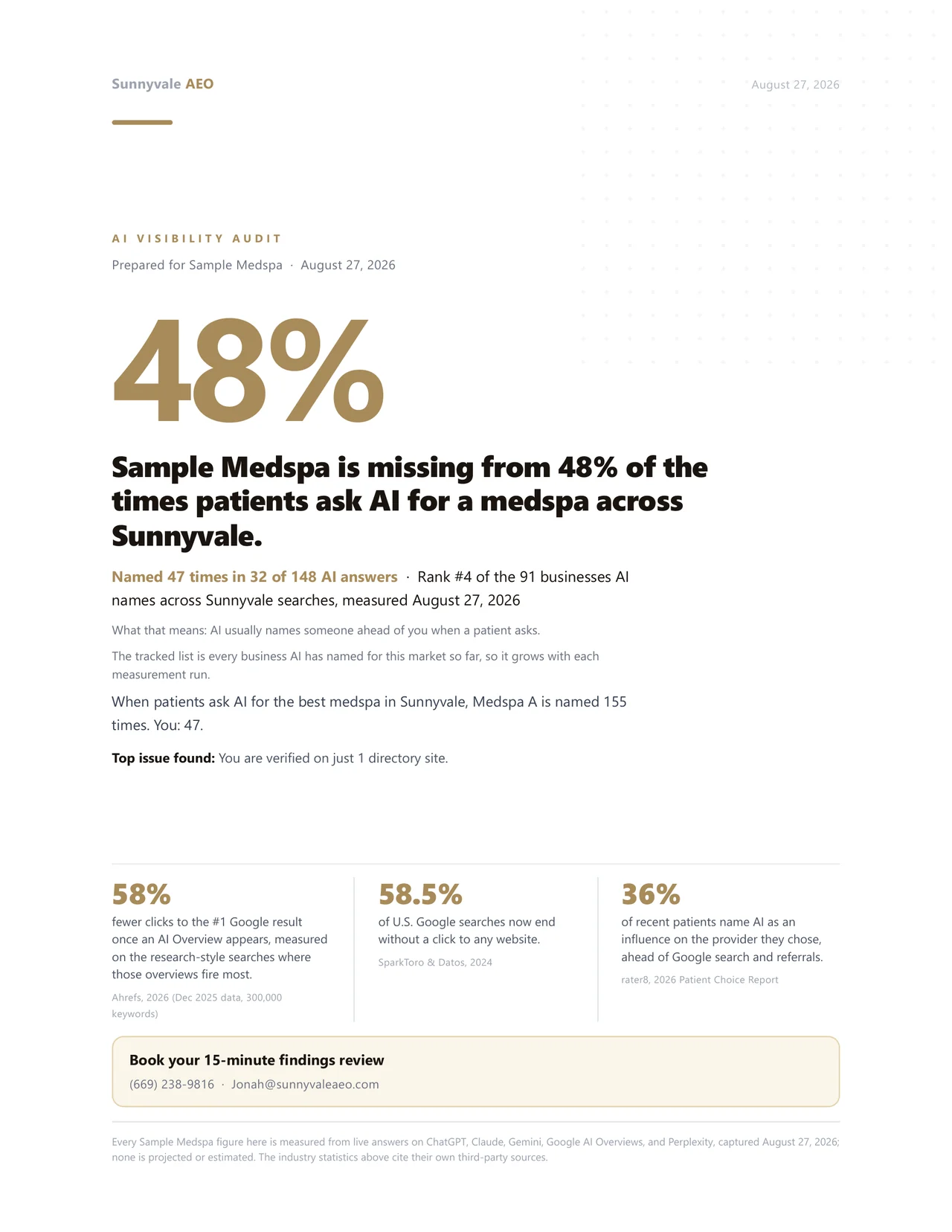
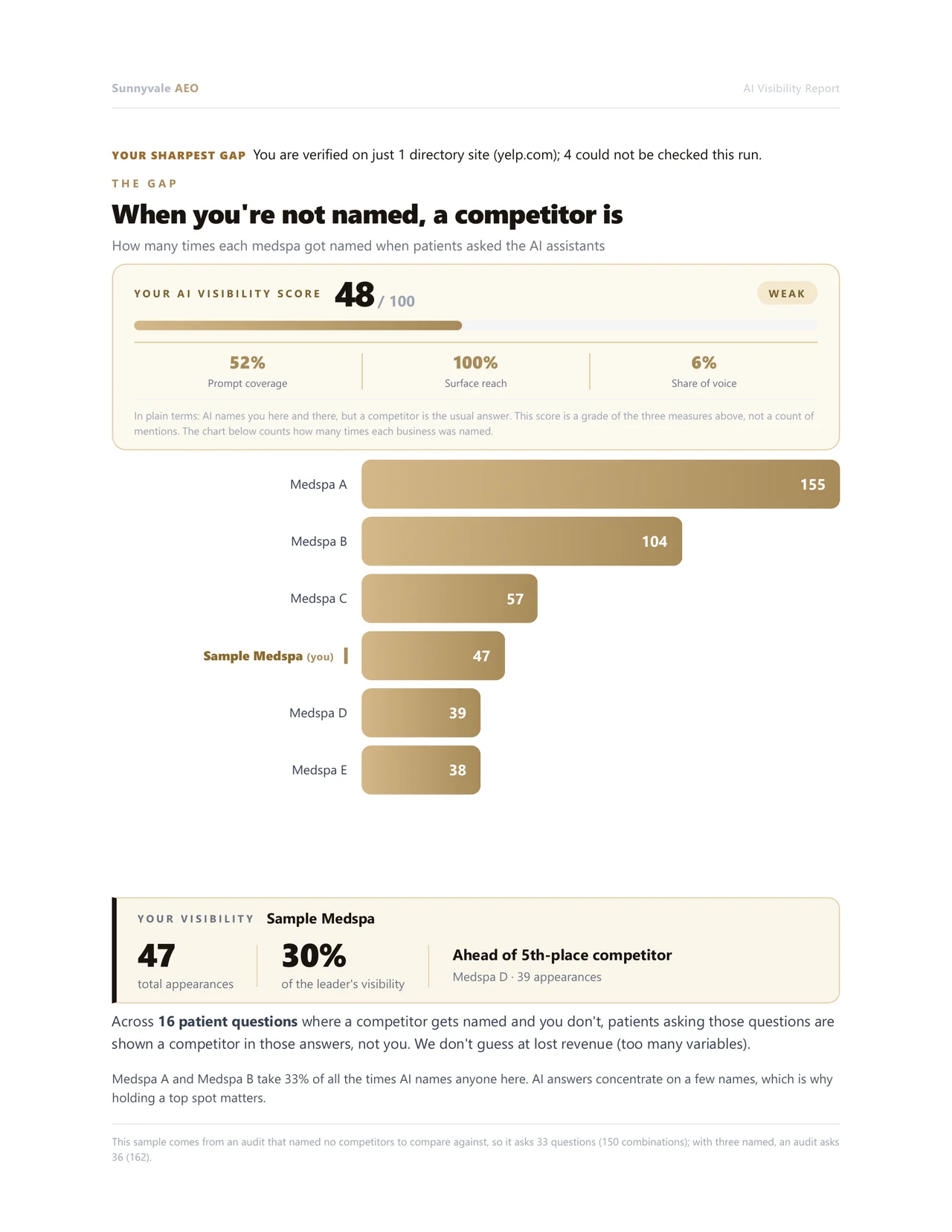
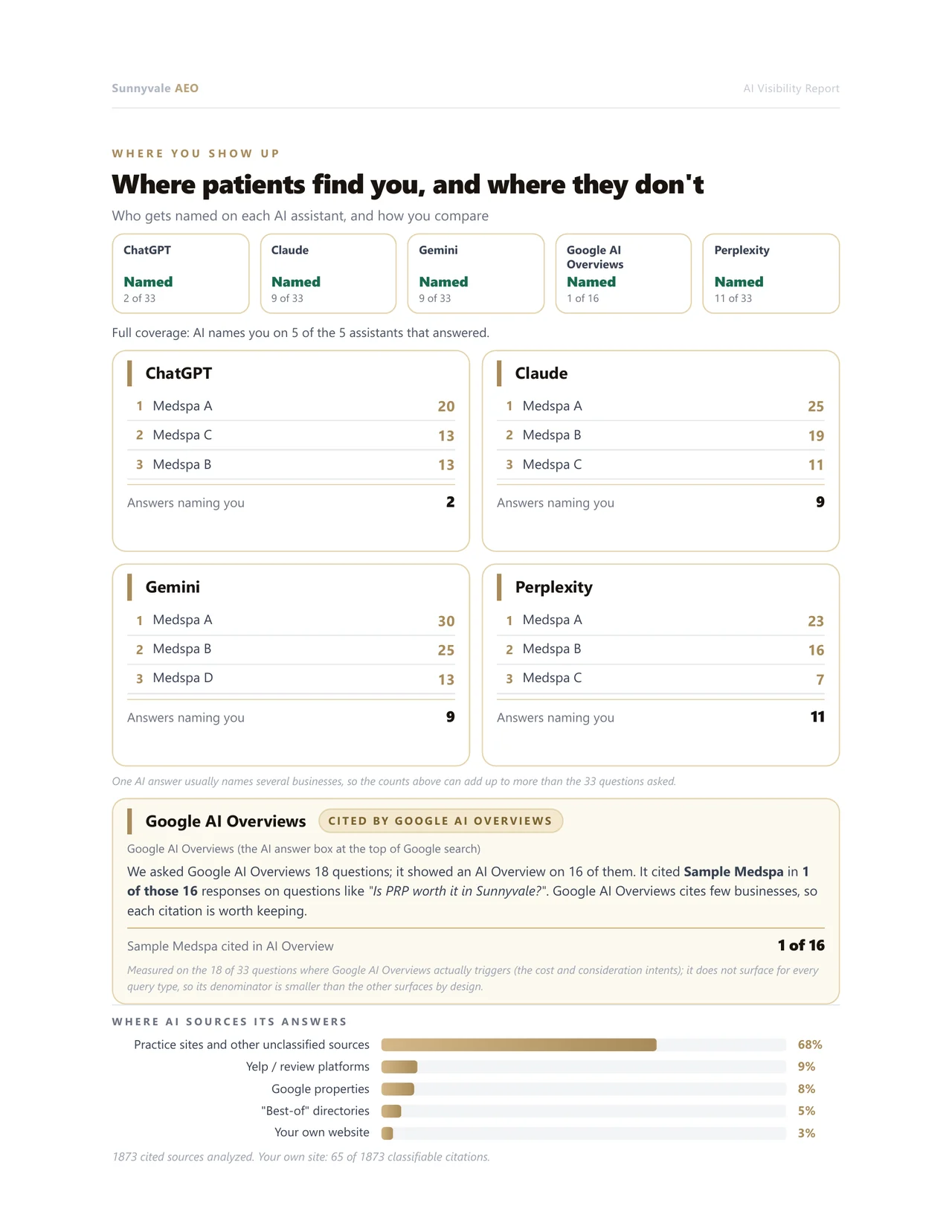
Our public sample report, August 2026, issued under our former name, Sunnyvale AEO. The business and its competitors are anonymized.
Open the full PDFDelivery Within 24 hours of intake, we walk the PDF to your front desk.
After the first fixes ship, we ask the same questions again and show you what moved.
If you go ahead, the next step is a 30-day re-measure: we ship the first fixes, re-run the same audit, and show you what moved. For active clients we re-score every month.
A re-measure, one real client · 3 of 5 surfaces
See what a re-measure looks like, and what it does not prove.
19%from 6%
Four things we do not claim.
The 30% commitment has a definition.
It counts the unique customer questions where at least one of the five surfaces names you, measured at the 90-day mark against the baseline audit on the same query basket (unique questions as the unit, not question-and-surface combinations). Where your baseline names you in fewer than 5 unique questions (including zero), it is instead an absolute increase of at least 3 additional unique questions where an AI surface names you, since a percentage of so small a base is not a meaningful measure.
It is also conditional on your cooperation: it applies only if you grant and keep the access we need, respond to our requests on time, and stay through your third monthly payment or the 90-day mark, whichever comes first, with the 90-day measurement window extended for any client-caused delay. The full conditions are in our Terms of Service.
We’re happy to walk through any of this in detail before you commit. Email Jonah@sunnyvaleaeo.com or request your audit.
Let’s audit your business